



Companies of all sizes are vulnerable to attacks that can compromise sensitive data and cause major business disruption. 60% of small businesses close within six months of a cyberattack. This highlights the real dangers organizations face, whether large or small.
One of the most effective ways to strengthen cybersecurity defenses is through a comprehensive cybersecurity assessment checklist. This tool helps businesses identify vulnerabilities, implement protective measures, and stay ahead of emerging threats
Joe Anslinger, Chief Technology Officer for Lieberman Technologies, says, “A thorough cybersecurity assessment checklist not only uncovers hidden risks but also helps businesses develop a proactive defense strategy.”
This blog will guide you through creating and using a cybersecurity assessment checklist to protect your business. You’ll find actionable steps to secure your data, strengthen your defenses, and stay ahead of potential threats.
What Does a Cybersecurity Assessment Checklist Cover?
A cybersecurity assessment checklist is a practical document compiled to reveal hidden gaps in your cybersecurity posture.
By following a structured checklist, you can identify areas of vulnerability that need improvement, ultimately leading to a more secure business environment.
Here’s a breakdown of what a comprehensive checklist includes:
- Security Policies: Ensure your policies align with current security standards and compliance requirements.
- Access Controls: Review who has access to what data and whether it’s appropriate.
- Threat Monitoring: Set up systems to monitor potential threats to your network.
- Physical Infrastructure: Don’t overlook the importance of physical security measures.
- Response Planning: Prepare your team for swift action in the event of a cyberattack.
Evaluating each of these areas helps you prioritize what needs immediate attention and what you can address later.
Cybersecurity Risk Assessment Checklist Breakdown
A solid cybersecurity risk assessment checklist provides detailed steps to evaluate every facet of your security.
The following sections break down the key areas of a cybersecurity risk assessment, helping you identify what you need to improve.
Identify Assets and Sensitive Data
Before you can protect anything, you need to know what you’re protecting. Identifying all digital and physical assets is the first step to protecting your business. This includes not only hardware and software but also sensitive data like customer information, financial records, and intellectual property.
Make sure to:
- Catalog all assets.
- Classify sensitive data based on its value and risk.
- Implement strong encryption for high-risk data.
Knowing exactly what assets you have will help you tailor your protection strategies to focus on the most critical parts of your business.
Determine Threat Sources and Likely Attack Vectors
Understanding where attacks are most likely to come from is vital to creating effective defense strategies. The common sources of cyber threats include external hackers, insiders with malicious intent, and even simple user error.
To assess threats, you should:
- Review past incidents and attack trends in your industry.
- Identify common attack vectors like phishing, malware, or ransomware.
- Look at vulnerabilities in your network and human factors, such as poor employee training.
Mapping out potential threats helps you proactively defend against them before they cause harm.
Evaluate Current Security Controls
Your current security tools are only as good as their configuration and use. A cybersecurity risk assessment checklist should evaluate how well your existing security controls are working.
Start by reviewing:
- Firewalls and antivirus software.
- User access controls and permissions.
- Encryption methods for data in transit and at rest.
Is your software up-to-date? Are your firewalls effectively blocking malicious traffic? These are the types of questions you should be asking to gauge the effectiveness of your current security systems.
| Review. Remediate. Recover. Repeat. Build an ongoing cybersecurity strategy that keeps you ahead, not constantly playing catch-up. Let’s Talk |
Measure Vulnerability Exposure
Even with the best security measures, there will always be vulnerabilities. Measuring how exposed your organization is to threats is a key part of your cybersecurity risk assessment checklist.
Consider:
- Regular vulnerability scans and penetration tests.
- Employee behavior analysis to identify weak spots.
- Tracking patch management practices to ensure all systems are up to date.
Continuously measuring vulnerability exposure helps you stay ahead of potential threats and ensure your defenses remain strong.
Assess Impact and Likelihood of Threats
Threats don’t pose the same risks. Some pose a higher risk to your organization’s operations, while others may be less likely to happen. Ranking threats based on their potential impact and the likelihood of a recurrence helps prioritize your security efforts.
For example:
- A ransomware attack could cripple your business operations.
- An employee clicking on a phishing link might result in a data breach, but it has less immediate impact.
Assessing the severity and likelihood of each threat helps you focus resources in the most critical areas.
Threat Assessment Checklist Cyber Security Teams Should Use
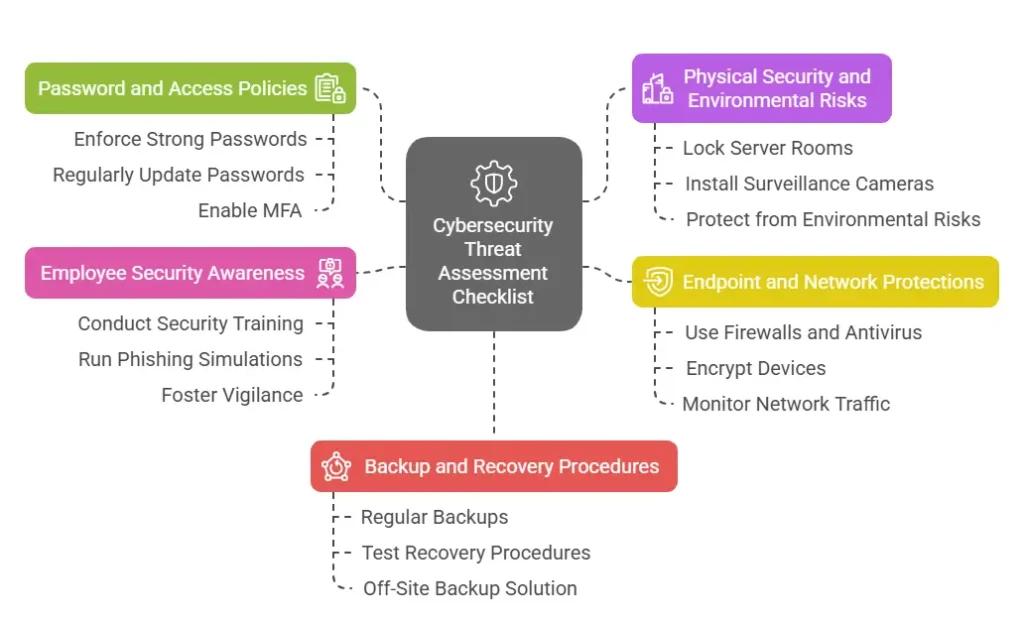
This section covers the essential tasks that your cybersecurity team should focus on to evaluate and mitigate risk.
Review Password and Access Policies
Weak passwords are a common entry point for cybercriminals. Ensure all employees use strong, unique passwords for every system, and implement Multi-Factor Authentication (MFA) where possible.
Review the following:
- Enforce strong password policies, requiring complex characters.
- Regularly update passwords and rotate access credentials.
- Enable MFA for an extra layer of security.
These actions drastically reduce the chances of unauthorized access.
Audit Physical Security and Environmental Risks
Physical security often gets overlooked in cybersecurity assessments, but it’s crucial. Ensure you lock your servers in secure, controlled environments.
Consider:
- Locking server rooms and restricting access to authorized personnel.
- Installing surveillance cameras in sensitive areas.
- Protecting your equipment from environmental risks like fire or floods.
Addressing these physical security measures adds another layer of protection.
Inspect Endpoint and Network Protections
Your network and endpoints are where data enters and leaves your business. You must tightly secure them to prevent unauthorized access.
Take these steps:
- Use firewalls, antivirus software, and VPNs to secure your endpoints.
- Encrypt all devices and regularly update their security patches.
- Monitor network traffic for unusual activity that could indicate a breach.
These precautions protect your endpoints from threats both internal and external.
Examine Employee Security Awareness
Human error is one of the biggest cybersecurity risks. CompTIA reports that 95% of breaches stem from human error. Phishing attacks, poor password management, and neglecting security protocols often happen because employees are unaware of risks.
To mitigate this:
- Conduct regular security awareness training.
- Run phishing simulations to test employees’ response to suspicious emails.
- Foster a culture of vigilance where employees report suspicious activity.
An informed workforce is one of your best defenses.
Test Backup and Recovery Procedures
What happens if you fall victim to an attack? Will your business be able to recover quickly? It is essential to test your backup and recovery procedures.
Ensure:
- Regular backups of all critical data are taken and stored securely.
- Test recovery procedures regularly to confirm that data can be restored quickly.
- Have an off-site or cloud backup solution in case of disaster.
These steps ensure you’re ready to recover from a cyberattack with minimal downtime.
How to Use the Cybersecurity Assessment Checklist Effectively
Once you’ve created your cybersecurity assessment checklist, it’s time to implement it effectively.
Use it as a tool to continuously evaluate and improve your cybersecurity posture.
Here’s how:
- Involve all key stakeholders in the process, from IT to upper management.
- Regularly update the checklist as your business and technology evolve.
- Use the checklist quarterly, or after major changes to your systems or staff.
Consistent use will make your security measures stronger and more reliable over time.
| Learn More About How You Can Manage IT Better |
Common Gaps Found Through Cybersecurity Risk Assessments
Even with the best cybersecurity measures in place, gaps can still exist. Here are some common weak points found during risk assessments:
- Overprivileged Accounts: Employees with access to more data than they need.
- Inactive User Access: Accounts for former employees who haven’t been deactivated.
- Weak Patch Management: Delays in applying important security patches.
- Poor Remote Work Protections: Inadequate security measures for remote workers.
- Lack of Incident Response Plans: No clear protocol for responding to a cyberattack.
By regularly reviewing these areas, you can patch security holes before they are exploited.
Comparing Reactive vs. Proactive IT Support
Most business leaders understand IT support is important, but few recognize the cost of choosing a reactive approach over a proactive one. Here’s how the two compare when it comes to outcomes that directly affect your operations and bottom line.
Signs You’re Ignoring Cybersecurity Until It’s Too Late
Many small to midsize businesses put off cybersecurity improvements until after a critical incident. By that point, the cost, financial and operational, is far higher.
The table below highlights what companies often delay and what those delays typically lead to.
| Neglected Action | What Happens Next |
| Ignoring software patches | Attackers exploit known flaws to access systems or disable applications. |
| Relying solely on antivirus software | Advanced threats bypass outdated detection tools and spread laterally. |
| Delaying MFA implementation | Unauthorized access goes unnoticed due to weak credential protections. |
| Skipping regular backup verification | Recovery fails when backup data is missing, corrupted, or improperly stored. |
| Failing to train users | Employees fall for phishing, grant access, or accidentally leak sensitive data. |
| Not having an incident response plan | Response is disorganized, leading to longer downtime and higher recovery costs. |
| Avoiding vulnerability assessments | Blind spots grow as systems and users change, creating unknown risk exposure. |
Choosing the Right Managed Services Provider with Lieberman Technologies
Cybersecurity isn’t an optional add-on; it’s a business-critical function that protects your productivity, systems, and reputation. The most secure businesses are the ones that act before problems spiral.
At Lieberman Technologies, we provide proven cybersecurity solutions built into every managed service relationship.
| Get Proactive cybersecurity in Evansville |
We support over 1,100 end users, maintain 123 managed services agreements across 73 companies, and resolve priority IT issues in as little as 1 hour.
Our team delivers security without delay, and our clients stay with us for a reason. Let us help you move from reactive to ready. Contact us today and secure what matters.
